

Distortion/Overdrive Whats The Difference

Im not new to playing guitars, ive been playing my acoustic for a year but im gettin a new electric for christmas, but iv never known what the difference between overdrive and distortion is, and ive asked my teacher and she doesnt kno, so if ya could tell me it would help out thanks
# 1

Overdrive is a type of distortion.....
I found this website that goes into detail....
http://users.chariot.net.au/~gmarts/ampovdrv.htm
I always considered Overdrive to be a natural distortion that comes from "overdriving" the tubes and Distortion as a "digital" form of overdrive.
Overdrive uses soft clipping.
Distortion uses hard clipping
Soft Clipping: This is usually marketed as "overdrive", where the gain is inversely proportional to the input signal level. This is typically produced either with back to back silicon signal diodes in the negative feedback path of an op-amp, or with germanium diodes or LEDs back to back in a shunt to ground.
Hard Clipping: Usually marketed as "distortion", where the signal level is restricted within a range. This is typically produced with silicon diodes back to back in a shunt to ground. This is the same as the circuit above, using silicon instead of germanium/LED diodes.
I found this website that goes into detail....
http://users.chariot.net.au/~gmarts/ampovdrv.htm
I always considered Overdrive to be a natural distortion that comes from "overdriving" the tubes and Distortion as a "digital" form of overdrive.
Overdrive uses soft clipping.
Distortion uses hard clipping
Soft Clipping: This is usually marketed as "overdrive", where the gain is inversely proportional to the input signal level. This is typically produced either with back to back silicon signal diodes in the negative feedback path of an op-amp, or with germanium diodes or LEDs back to back in a shunt to ground.
Hard Clipping: Usually marketed as "distortion", where the signal level is restricted within a range. This is typically produced with silicon diodes back to back in a shunt to ground. This is the same as the circuit above, using silicon instead of germanium/LED diodes.
Check out my band:
Havoc Din
Havoc Din
# 2
K thanks man much appreciated,
i was told that greenday used overdrive alot with there songs so would that be the overxdrive they use for songs like american idiot and minority or would that be distortion
i was told that greenday used overdrive alot with there songs so would that be the overxdrive they use for songs like american idiot and minority or would that be distortion
# 3
Originally Posted by: young/youngK thanks man much appreciated,
i was told that greenday used overdrive alot with there songs so would that be the overxdrive they use for songs like american idiot and minority or would that be distortion
Your welcome!!
That I don't know, I'm not a fan of Greenday.
Check out my band:
Havoc Din
Havoc Din
# 4
# 5

I always thought of em as being the same thing.
Sorta like a 'fuzz pedal' from years ago.
Sorta like a 'fuzz pedal' from years ago.
# 6
the greenday sound is overdrive. at their thickest sound, it's a really high overdrive.
okay...my post is done...goodbye.
# 7

Overdrive is a bit smoother and more tube like, and distortion has more sizzle and more saturation.
# 8
# 9
Overdrive tends to have a smoother, "sweeter" sound, found in a lot of 70's classic rock, like Neal Schon from Journey. A bit more modern example would be Slash from Gun's & Roses. Overdrive is often an accompanied by reverb and delay, a little or a lot, subtle or really noticeable, especially for solos. Pete Townsend from "The Who" would be a good example of overdrive being used without a lot of other effects.
Distortion has a more brittle, abrasive sound, found more in punk & metal. As PRSplaya has said, a more saturated sound, the idea being to really blend the notes together into one "crunchy" sound. A really good example of distortion is the guitar in "Creep" (I think the band is "Radio Head"?)... that really abrasive rhythm guitar that leads into the chorus. Nine Inch Nails is another good example of an over-all guitar sound that is based more on distortion than overdrive. Marylin Manson "Beautiful People" would be another distortion example. Distortion tends to be used without any other "spacial" effects like reverb or delay, but nothing says you can't use these effects, its just most guitarist using distortion are going for that dry, brittle sound.
You can probably get overdrive to sound more like distortion and distortion to sound more like overdrive, but it gives you and idea what the designers of the amp, pedal, rack or effect plugin had in mind when you see it labeled one or the other.
Distortion has a more brittle, abrasive sound, found more in punk & metal. As PRSplaya has said, a more saturated sound, the idea being to really blend the notes together into one "crunchy" sound. A really good example of distortion is the guitar in "Creep" (I think the band is "Radio Head"?)... that really abrasive rhythm guitar that leads into the chorus. Nine Inch Nails is another good example of an over-all guitar sound that is based more on distortion than overdrive. Marylin Manson "Beautiful People" would be another distortion example. Distortion tends to be used without any other "spacial" effects like reverb or delay, but nothing says you can't use these effects, its just most guitarist using distortion are going for that dry, brittle sound.
You can probably get overdrive to sound more like distortion and distortion to sound more like overdrive, but it gives you and idea what the designers of the amp, pedal, rack or effect plugin had in mind when you see it labeled one or the other.
# 10
Technically, distortion is any change in the signal as it propagates through the circuit. There is always some distortion, even in a clean tone, because there is no perfectly linear amplifier.
Real over drive is a condition where an amplifier is pushed beyond it's design limit. A pre-amp or power amp is designed to work in a linear range (not perfectly linear) for certain input signal voltage levels. When the input signal is beyond the expected level then the output signal will be distorted due to the circuitry being over driven. In just about any other field of audio this would be a bad thing. We guitarist think it sounds cool. :)
Unlike other audio applications, guitar amps are now designed to distort things on purpose. Much of what we call distortion is really an attempt to emulate a dramatically over driven signal.
Now we have devices (pedals or circuitry built into the amp) that attempt to emulate various stages of over drive and other affects. You can tell that it's not real over drive because the fuzzy tone doesn't change with volume.
Cheers,
Real over drive is a condition where an amplifier is pushed beyond it's design limit. A pre-amp or power amp is designed to work in a linear range (not perfectly linear) for certain input signal voltage levels. When the input signal is beyond the expected level then the output signal will be distorted due to the circuitry being over driven. In just about any other field of audio this would be a bad thing. We guitarist think it sounds cool. :)
Unlike other audio applications, guitar amps are now designed to distort things on purpose. Much of what we call distortion is really an attempt to emulate a dramatically over driven signal.
Now we have devices (pedals or circuitry built into the amp) that attempt to emulate various stages of over drive and other affects. You can tell that it's not real over drive because the fuzzy tone doesn't change with volume.
Cheers,
# 11
# 12
Ahhh...and a good year it was...
"It takes a lot of devotion and work, or maybe I should say play, because if you love it, that's what it amounts to. I haven't found any shortcuts, and I've been looking for a long time."
-- Chet Atkins
-- Chet Atkins
# 13
Originally Posted by: hunter1801This thread was made in 2005...don't bump old threads
Why not?
Is there a time limit on threads?
# 14

Originally Posted by: hunter1801This thread was made in 2005...don't bump old threads[/QUOTE]Originally Posted by: mhowell67Why not?Good stuff!
Is there a time limit on threads?[/QUOTE]No, there's no time limit. Using the Search feature can reveal a treasure trove of information that was posted on questions that are being asked again by new members.
(see below)
[QUOTE=mhowell67]Technically, distortion is any change in the signal as it propagates through the circuit. There is always some distortion, even in a clean tone, because there is no perfectly linear amplifier.
Real over drive is a condition where an amplifier is pushed beyond it's design limit. A pre-amp or power amp is designed to work in a linear range (not perfectly linear) for certain input signal voltage levels. When the input signal is beyond the expected level then the output signal will be distorted due to the circuitry being over driven. In just about any other field of audio this would be a bad thing. We guitarist think it sounds cool. :)
Unlike other audio applications, guitar amps are now designed to distort things on purpose. Much of what we call distortion is really an attempt to emulate a dramatically over driven signal.
Now we have devices (pedals or circuitry built into the amp) that attempt to emulate various stages of over drive and other affects. You can tell that it's not real over drive because the fuzzy tone doesn't change with volume.
Cheers,
[QUOTE=Lordathestrings] From January, 2007:
Overdrive is what happens when the front end of an amp is fed a signal that is strong enough to saturate one or more of the gain stages. The incoming signal can be clean or already distorted; doesn't matter. The point is, that the level is high enough to cause the amp to distort. Usually, an overdrive pedal pushes a strong, clean signal. The resulting distortion is produced within the amp. If the amp has smooth distortion characteristics, you'll get smooth distortion. If you overdrive a transistor amp that was not designed for 'nice' distortion, it won't sound smooth at all.
Distortion pedals deliver a distorted signal. Yeah, really! The output could be turned down so that it was nowhere near strong enough to overdrive an amp, and the sound would still be distorted. This is useful in situations where you can't crank a tube amp up enough to get it to distort on it's own. Or it can add extra crunch when fed into a cranked amp.
There are differences in the sound of distortion generated in a pedal or in the preamp, and distortion generated in the power stage of a tube amp. A distortion pedal can't generate power-stage distortion without also creating preamp distortion. An overdrive pedal will cause the most sensitive stage of the amp to distort. What stage that is, depends on the amp design and the control settings. Which setup you prefer, depends on what you're playing, and what you want it to sound like.
# 15
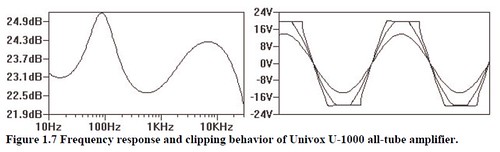
Hard clipping is not solely the domain of transistors.
http://farm6.staticflickr.com/5036/7085534681_6b73610dd8.jpg
http://farm6.staticflickr.com/5036/7085534681_6b73610dd8.jpg
# 16
Originally Posted by: mhowell67Hard clipping is not solely the domain of transistors.Thanks for the info. I've never seen that before. I'll see if I can find out why that happens.
http://farm6.staticflickr.com/5036/7085534681_6b73610dd8.jpg
# 17
Back in the late 1960's, some guitar players would razor a slit or tow in the speaker cone to produce a distorted effect, lol!
In 1968, the 1st decent distortion effect I heard of was named a "Jordan Buzztone", which was a metal box about 2" square, which was run by a 9 volt battery with dial pot switches. The unit has a 1/4" mono plug and plugs directly into the input jack of the guitar.
I had one of the 1st commercial floor fuzz boxes which were made by a company named "Crown", I believe. The pedal had 2 channels with a tone knob and a volume knob. Neither channel sounded as good as the Jordan Buzztone, but the Crown was $40 cheaper.
You can still buy the Jordan Buzztone and they even have a kit, by which You can build one!
Click on the attachment below to see a Bosstone.
In 1968, the 1st decent distortion effect I heard of was named a "Jordan Buzztone", which was a metal box about 2" square, which was run by a 9 volt battery with dial pot switches. The unit has a 1/4" mono plug and plugs directly into the input jack of the guitar.
I had one of the 1st commercial floor fuzz boxes which were made by a company named "Crown", I believe. The pedal had 2 channels with a tone knob and a volume knob. Neither channel sounded as good as the Jordan Buzztone, but the Crown was $40 cheaper.
You can still buy the Jordan Buzztone and they even have a kit, by which You can build one!
Click on the attachment below to see a Bosstone.
# 18